








I was born in Brazil to an American father and a German mother, and I entered the world with triple citizenship—an early hint that my life would be shaped by movement, perspective, and cross-cultural fluency. Because my father’s career took our family around the world, I spent my childhood living across six countries and three continents. That constant exposure to new environments taught me how to adapt quickly, communicate across contexts, and see systems—human and technical—as interconnected realities rather than isolated parts. When I returned to the United States to pursue computer science, I carried that worldview with me: curious, globally minded, and wired to learn fast.
Craftsmanship, not just a career
From my earliest memories, it was obvious that software engineering wasn’t simply a job path—it was a calling. I felt it first through play: gripping the joystick of an Atari 2600, exploring classics like Pac-Man and Asteroids, and sensing the beginnings of digital worlds that were somehow both mechanical and magical. That interest deepened when my father brought home our first IBM PC. I was captivated not only by what it could do, but by how it worked: the rhythm of the boot sequence, the logic behind the machine’s behavior, and the physical ritual of floppy disks that carried entire universes in a few inches of plastic.
Even then, the fascination wasn’t “computers” in the abstract—it was systems. The way simple rules created complex outcomes. The way invisible logic could become visible experience. The idea that human creativity could be translated into something precise enough for a machine to execute.
Early foundations: learning the machine from the inside out
As my curiosity matured, I moved from imitation to exploration. A pivotal moment came in middle school when I stumbled into programming through the language of BASIC—simple enough to begin, powerful enough to open the door. Not long after, I found myself absorbed in deeper references that explained how computing worked at the hardware level. The more I learned, the more I wanted to understand: not just “how to code,” but how to design, build, and refine systems that were resilient, elegant, and understandable.
Parallel to that, my love of gaming pulled me toward graphics, interaction, and experience design. I progressed from basic control flow into PASCAL, then into more advanced work with C++ and DirectX—drawn to the intersection where engineering becomes artistry: interactive worlds, real-time constraints, and the challenge of turning imagination into something users can feel.
Three decades of building interface systems at enterprise scale
By the mid-90s, the dotcom era was accelerating and I was all in. Over the next three decades, I built a career around front-end engineering and interface architecture—not as “making screens,” but as designing the systems behind them: component models, state management strategies, design tokens, performance discipline, and the operational realities that make large applications coherent over time.
I’ve worked across industries and problem spaces, but the recurring theme has been consistent: I’m at my best when I’m building platform-grade UI foundations—the kind that make teams faster, experiences more cohesive, and enterprise workflows safer and easier to evolve. I love the details, but I also love the orchestration: aligning product intent, technical constraints, and a long-term architecture that won’t collapse under success.
Entrepreneurship and ownership mindset
Complementing my technical career, I’ve founded and operated independent software ventures—one of them spanning years as a serious enterprise effort, and more recently launching Happy Clam in 2020. Entrepreneurship sharpened a skill set that traditional roles don’t always require: shipping with discipline, making tradeoffs with clarity, and building systems that respect real-world constraints—time, budget, and human attention—without sacrificing quality.
That ownership mindset still defines how I work today. I don’t just “implement.” I shape direction, identify leverage points, and design execution so that teams can move with confidence rather than chaos.
The past year: AI as the culmination of a lifelong curiosity
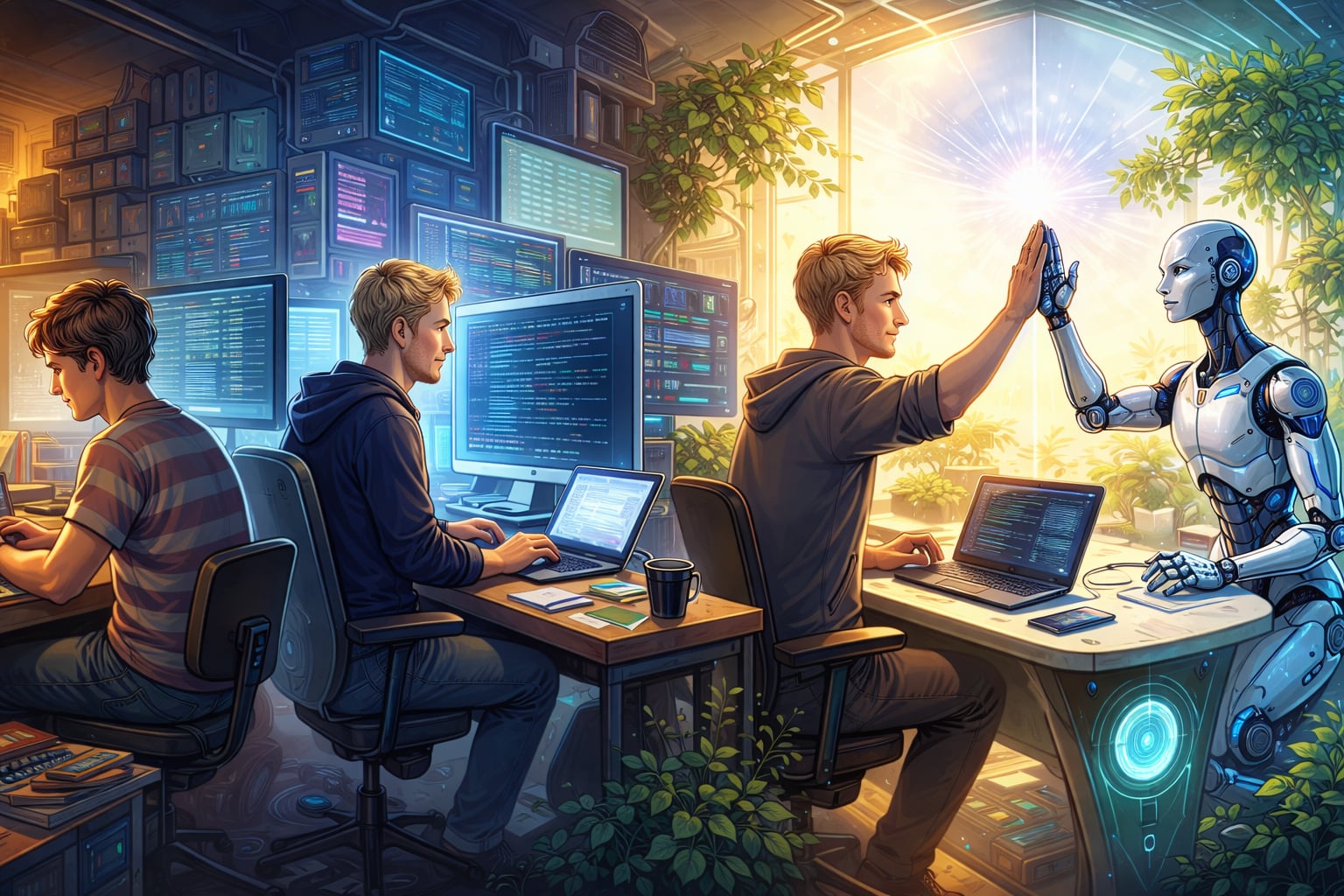
Over the past year, my journey has become even more transformative. Artificial intelligence—especially modern large language models and agentic tooling—has taken something I was fascinated by as a kid (synthetic intelligence, machine reasoning, human-computer collaboration) and made it real in my day-to-day work.
For me, AI isn’t a novelty or a shortcut. It’s a force multiplier for craftsmanship—when paired with strong fundamentals, high standards, and clear intent. I’ve leaned deeply into AI-augmented engineering workflows to accelerate discovery, reduce iteration cycles, and raise the quality bar: using models as collaborators for design exploration, architecture validation, test strategy, documentation, and high-velocity implementation. The result is not “less thinking”—it’s more thinking, applied faster, with tighter feedback loops and higher ambition.
In many ways, it feels like a dream realized: the future I imagined—humans building alongside intelligent machines—has arrived, and I’m fully at home in it.
Life beyond the keyboard: clarity, balance, and creative fuel
Outside of engineering, I intentionally build a life that sustains creativity. Home is shared with three Siamese cats and a spirited Dachshund—an everyday reminder that joy and unpredictability are part of any good system. From early spring through late fall, sailing on the Chesapeake Bay gives me the kind of mental reset that no screen can replicate: quiet focus, changing conditions, and the discipline of navigating by fundamentals.
Travel remains an essential influence, shaped by my multicultural upbringing. And recently, photography has become a powerful creative outlet—another form of systems thinking, in a way: light, timing, composition, patience, and the art of seeing what others might miss.
What I bring to the table
At the core of my professional ethos is a simple truth: human potential is vast, but attention and resources are finite. Excellence requires focus. It requires choosing the right problems, building the right foundations, and executing with care—without getting trapped by perfectionism.
That principle has guided my leadership, my architecture, and my delivery style throughout my career. I bring a rare combination: deep technical craftsmanship, global perspective, an ownership mindset, and a modern AI-harmonized approach to building software. My work is about designing systems that last, experiences that feel effortless, and platforms that help teams move faster than they thought possible—without losing quality, coherence, or soul.
I’ve spent a lifetime learning how machines think. Now, in an era where they begin to think alongside us, I build the systems that ensure we remain intentional, precise, and in control of what we create.